
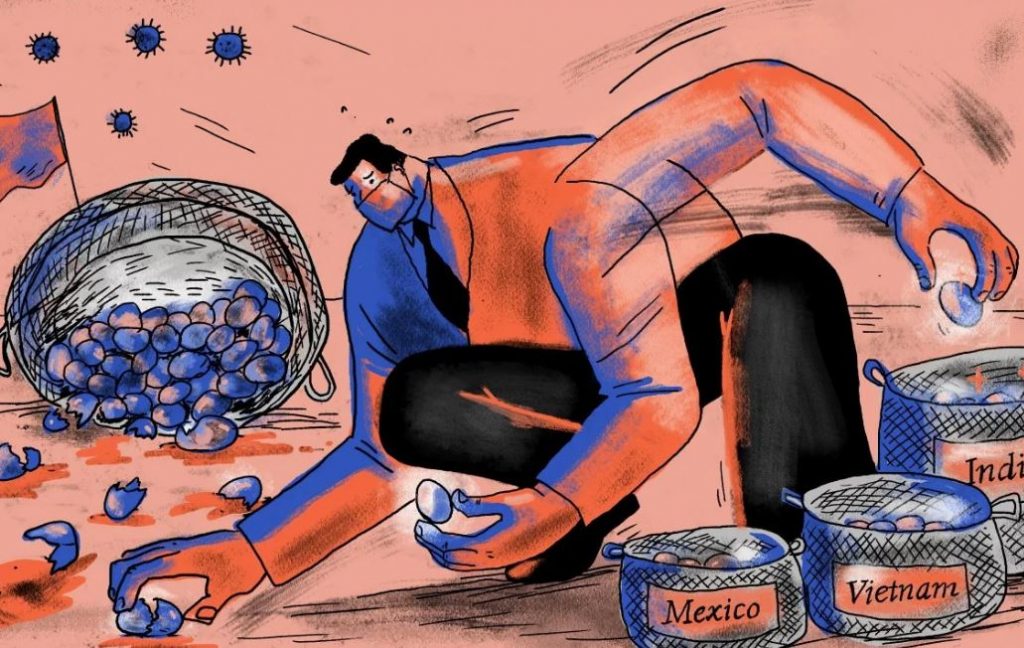
This is part of a five-part series looking at how the coronavirus epidemic affects China’s relationships with the rest of the world. Part two focuses on how the coronavirus has shaken the commitment of multinational companies working in China, and whether it may lead to another wave of manufacturing exits.
Some are celebrating the decision to leave, others are regretting their decision to stay, while the rest have no choice but to lick their wounds and count their losses.
For some, having already dealt with rising wages, burdensome governance and a bruising two-year tit-for-tat tariff slug out with the United States, the coronavirus outbreak, which has ripped through the country’s economy and upended the global supply chain, is the last straw.
“For most multinational companies, my sense is the virus has shaken their commitment that China remains a place to be,” said Ken Jarrett, a former US diplomat in China who now advises foreign businesses on their China strategy for Albright Stonebridge Group.
A director at a global manufacturing giant said the outbreak, which laid waste to China’s famed production heartland for weeks, was their “told you so moment”, reaffirming their decision to leave China
“[Thecoronavirus] confirmed that we were too reliant on one country and that moving out was the right move,” said the director, speaking anonymously, who has been helping spearhead the company’s transition out of China.
Now, with the risks of being too exposed to China made plain and production at their Chinese plants languishing at around 50 per cent, the company will speed up their exit.
mitigation strategy are simply continuing those plans indefinitely. On the other hand, companies that had not taken diversifying tactics at the height of the trade war are now regretting it.”
Isaac Larian, the CEO of MGA Entertainment, an American toy company, said that his production remains at the mercy of the volatility in China. He already worries about how the impact of the virus will hit peak shopping periods such as August, before children in the US and Europe go back to school, and even Christmas.
“In four decades doing business in China, the coronavirus is the worst thing to happen,” said Larian. “People do not realise that this is going to be a major disruption to consumer goods.”
Larian has not followed the crowd of manufacturers fleeing for new pastures, instead, 85 per cent of MGA’s merchandise, and 99 per cent of his top product, LOL Dolls, are still made in China.
do not have the workforce or infrastructure to compete. “In my opinion, for the next 10 years, there is no way to get out of China.”
Larian’s view that “no other country can do what China does” stands up to scrutiny.
China has 1.4 billion people, a world-class logistical network, and decades of manufacturing experience unrivalled in alternative hubs. Many companies find it difficult or impossible to leave, while the scale of the country means most big companies will need to retain some manufacturing presence in the mainland, even as they reduce their overall reliance.
“China’s manufacturing base still casts a long shadow across Asia. Its experience, supplier networks and breadth of product knowledge are difficult to replicate on a similar scale,” said Simon Archer-Perkins, chief operating officer at ET2C International, a sourcing company. “We have also seen greater flexibility on order size and depth of products when compared with other markets as well as a willingness to invest at factory level in more specialist capabilities.”
But many companies who have moved some or all their production out of China have their eyes wide open to the deficiencies of new locations. They will not be as well-oiled, efficient, or reliable, but they will be cheaper and, they hope, carry less risk.
“We were all kind of comfortable, China has for the past 30 years done a really amazing job to become the world’s workshop. It’s not been easy by any means to do business [in China], but it has got really good and companies have relied on it. They got fat and happy.”
Now, with the coronavirus proving such a huge disruption, big-name companies like Microsoft and Google are moving production to other Asian hubs, mainly Vietnam and Thailand.
Board rooms around the world have become “war rooms”, as executives try to calculate their exposure to China and figure out how to reduce it
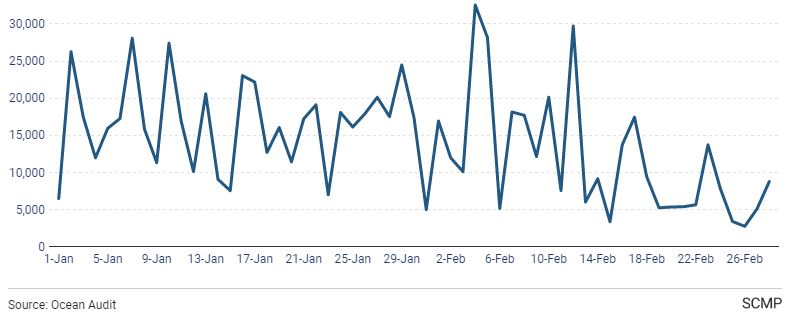
arriving daily at US ports from China fell from 32,550 on February 4 to just 2,784 on February 26, according to figures provided by Ocean Audit, a maritime data firm.
“I have 16 of the Fortune 100 [top companies] as clients and I would say half of them are still in the ‘war room mentality’,” said Steve Ferreira, Ocean Audit’s founder. “They’re managing the fallout with Chinese suppliers, vendors, agents, manufacturers and logistics companies. Those who have no immediate out from China were, as late as last Friday, deep in planning.”
An adviser to two European firms in the home goods sector said the virus caused them to leave China for Eastern European manufacturing sites, in conjunction with their Chinese partners.
“This is not a trade war issue, they see the short term disruption as an opportunity to offset the initial capital costs, and long term, European customers will give them preference for having a European origin,” said Will Marshall, a trade lawyer at Tiang and Partners in Hong Kong. “Trade wars, phase one, viruses, do not create the drive to move out of China, they just erase doubt and motivate more aggressive steps to take.”
However, for most companies the decision on supply chain diversification came before the coronavirus, and in some cases, the latest shock acted as a galvanising influence, but very few are only now considering it for the first time.
A recent survey by the American Chamber of Commerce in China found that only 2 per cent of respondents were “considering exiting the China market” as a direct result of the coronavirus, while a further 4 per cent “considering relocation of some or all manufacturing out of China”.
“We have been moving production from China to Vietnam and other Southeast Asian countries very quickly in the last two years,” Szeto said. “First Chinese costs were rising, then came the trade war when American customers demanded that we move production out of China. The virus is just going to exacerbate that trend. A few years ago, China was the lion’s share of our production. Today, Vietnam now accounts for more than half and China is second.”
Others do not have such a decision to make, such as the Chinese arm of Austrian engineering giant Andritz.
“We have the biggest manufacturing presence of the whole group in China, so we have big exposure,” said Schmitz. “But when you look at our business model, roughly 80 per cent of our business is what we are doing on our own mainly for customers in China, but also Southeast Asia. We are much more dependent on the local Chinese market.”
As Beijing desperately tries to make up lost economic ground, experienced China observers expect the government to reach out to foreign companies in an effort to convince them to stay.
“We might start seeing local governments offer more support, as they did a the height of the trade war,” said Jarrett from Albright Stonebridge Group.
But as more items made in China disappear from shelves and consumers and shareholders start demanding answers, these companies will continue to face more pressure to leave.
“We could see more companies again starting to ask, is this another nail in the coffin of China as the global hub of manufacturing?” Jarrett said.
Fonte: www.scmp.com